The President Street building opened in January 1911
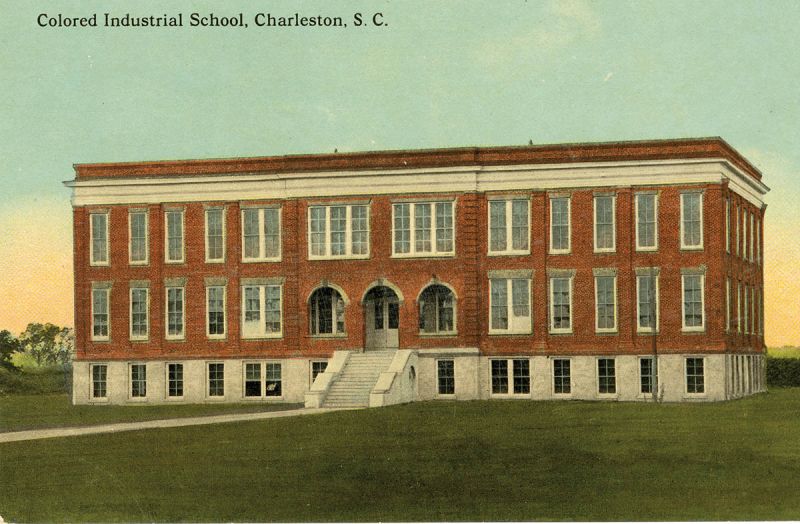


In early January 1911, a new building, just inspected by US President William H. Taft, opened at 244 President Street in downtown Charleston. With it began a new and long overdue chapter in the history of local African American education and self-determination.
Back in 1894, Reverend Benjamin Dart (1854-1915), with no public support from the city, had launched the Charleston Normal and Industrial Institute in his home to train Black youth. With such great need, the school grew, and soon, a new building for the institution, Dart Hall, was constructed on the corner of Bogard and Kracke streets.
After years of lobbying by the community and its leaders, the City of Charleston allowed the transfer of Dart’s school, renamed the Colored Industrial School, into a new two-story, brick building on President Street, financed with municipal funds. In 1911, the press lauded its “latest modern conveniences” with wood-burning stoves in all 14 rooms, separate desks for each student, and instead of blackboards, green ones that were deemed “more restful to the eyes.”
About 375 students were transferred from various all-Black elementary schools. All the teachers, now on the public payroll, were white, but that rule was overturned by activism spearheaded by the local NAACP chapter in 1919.
At first, it was to be a trade school, teaching boys carpentry, bricklaying, agriculture, and the like, and girls cooking, sewing, and laundering. In 1921, the name was changed to Burke Industrial School, after the death of J.E. Burke of the school board. By 1923, 11th grade had been incorporated and 12th grade was added in 1948.
Burke later absorbed students from the Avery Normal Institute after it closed in 1954. Winning accreditation by the Southern Association of Colleges and Secondary Schools that same year, Burke was then the only such acknowledged public Black high school in the city and among the few in the state.
Over the years with the closing of other schools, such as C. A. Brown, Rivers, and Charleston High, Burke became the only public high school on the peninsula. With a modern campus of two city blocks near Johnson Hagood Stadium, the school is a monument to the city’s own evolving education as the school itself continues to educate future generations.