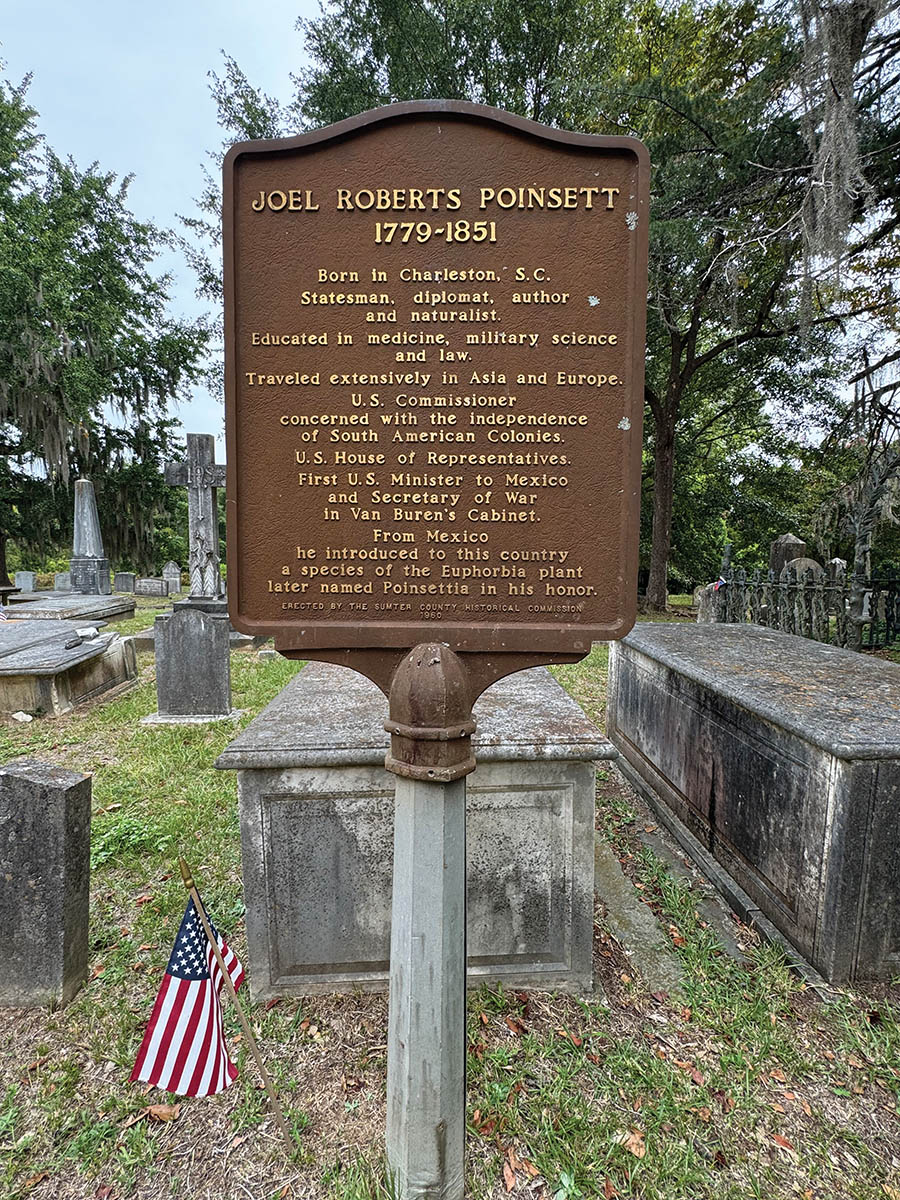
December 12 is National Poinsettia Day
It’s the perfect trivia question: which Charlestonian has a day on the national calendar named for him? The answer: Joel Roberts Poinsett, who was born here on March 2, 1779.
In 1801, after training as an attorney, Poinsett set off to educate himself further through travel—and not just via the then-standard European tour. When he stopped in Russia, Czar Alexander I tried to recruit him to join his government in Moscow, but Poinsett declined, after offering advice that Russia should not grow cotton. He then journeyed to the Caspian Sea, becoming one of the first Western travelers of the era to investigate the Middle East.
After meddling in international affairs in Chile and Argentina, Poinsett returned to South Carolina, where his fellow citizens elected him to the State Legislature and later to the US House of Representatives. When the United States recognized the Republic of Mexico in 1825, he became our first ambassador to the country and later served as secretary of war from 1837 to 1841 under President Martin Van Buren. During that time, Poinsett’s department oversaw the removal of indigenous peoples west of the Mississippi in what became known as the Trail of Tears.
Dedicated to US government policies (he was pro-Union when South Carolina tried to nullify US laws in the 1830s), Poinsett had other interests, as well: as a young man in Persia, he had seen a pool of petroleum and believed it could be used as fuel one day. Later, in 1840, he helped launch the National Institute for the Promotion of Science and the Useful Arts, which advocated for the creation of what became the Smithsonian Institution.
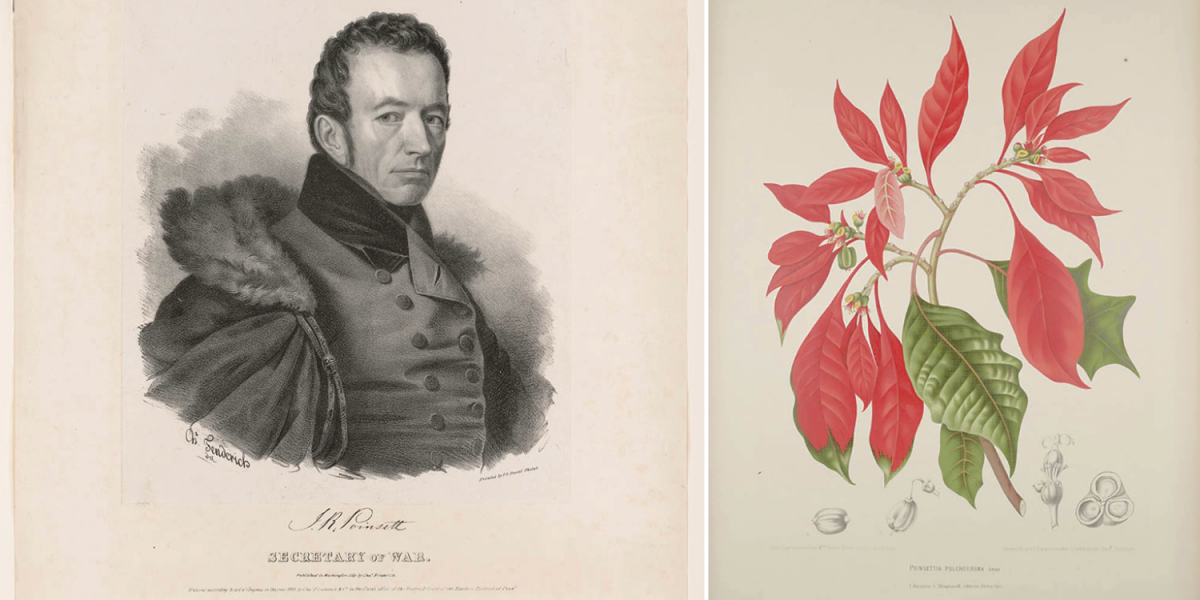
However, it was Poinsett’s interest in botany that made him a household name. In 1828, during his sojourn in Mexico, he became intrigued with a scarlet-leafed plant indigenous people called the cuetlaxochitl (kwet-la-SHO-sheet), translated as the “flower that withers.” The Spanish called it “flor de Nochebuena” or “flower of Christmas Eve,” and it became associated with the holiday after Poinsett sent cuttings home, where it was dubbed the “Poinsettia.” In 2002, by act of the US Congress, December 12 became known as National Poinsettia Day in memory of the man who had died on the date in 1851, just as the leaves were turning red.