See the retrospective beginning January 30 through May.
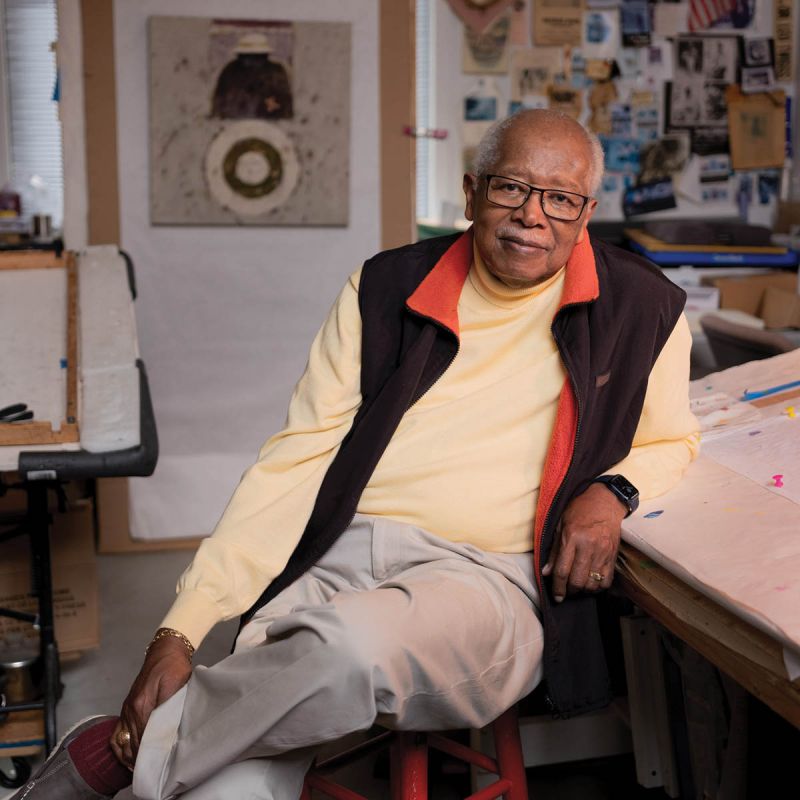


His retrospective at the Gibbes runs through May 3.
During his six-decade career, Leo Twiggs has transformed the ancient technique of batik into a powerful medium for exploring memory, history, and the human condition. The first African American to earn a doctorate in art education from the University of Georgia, the pioneering South Carolina artist has spent his life confronting difficult truths about the South through his art, reclaiming symbols of hate, such as the Confederate flag, and transforming them into opportunities for healing and dialogue.
A distinguished artist in residence at Claflin University, Twiggs was the first South Carolina artist to win the Gibbes Museum of Art’s 1858 Society Prize for Contemporary Southern Art in 2018. Fifty years after his first solo show at the Gibbes in 1976, his retrospective, “Revelations! The Art of Leo Twiggs,” runs from January 30 through May 3. Here, the artist looks back on his visionary career.
Art Education: I learned on my own by looking at comic books like Red Ryder and trying to draw what I saw. Our school system used to have a field day for the whole district, where the schools would get together and have an art exhibition. I remember taking a piece of wallpaper, because I wanted a big piece of paper, riding my bike to school, lying on the ground, and drawing the main building of the school on the wallpaper. Everyone loved it. Soon, teachers started asking me to do their bulletin boards.
Changed Course: One day, the minister of a white Baptist church asked if I was going to college, and I said no—I was the oldest of five brothers and a sister, and I had to work to feed the family. (My father died when I was 15.) He asked how I did in school, and I told him I graduated as valedictorian. He called my mom and said he was going to pick me up and to have my artwork ready. I sat in the back seat because you couldn’t sit in the front with a white man. He took me and my art to Claflin University with no application or anything. The president of the college gave me a work scholarship but said I had to pay tuition. My mom sold one of our cows to pay it, and I worked cleaning up the art studio. I never got to see the minister again, but he changed my life, and the course of my family’s lives.
Discovering Batik: I was at the Art Institute of Chicago one summer during grad school, when one of the professors taught a unit on batik. She wore batik scarves, and I was fascinated with the color quality. When I went back to teaching, I taught the kids. With batik, you have to let the fabric dry between colors before applying the wax. Historically, batik was used for fabric to make clothing, wall hangings, and other utilitarian things. I wanted to find a way to mount it on a board like a painting. It took a lot of time; I had to learn how to control it and dry-mount it on board. I experimented until I found the right materials. Every painting is a long process; it takes about a month. I love it because it makes you more contemplative; you have to think about where you’re going.
Imagery: I used to tell my students all the time; you paint out of your experience. With the Confederate flag, you see it every day, and you know what it’s about. I always thought it was a relic of the past, yet people worship it as if it were yesterday. So, I did a series called “Commemoration.” I took the flag and made it a relic, old and tattered, something from the past that should be in a museum. I wanted people to compare that with the polyester flag they flew on top of the Statehouse. The more you look at it, the more you see the irony.
In Retrospect: When I started working in 1961, African American artists were a by-product. In the Civil Rights Era, when Blacks were asking for their rights, people looked at Black art as something primitive. They didn’t think it was important art. It was a tumultuous time, and my work was exclusive because I was working in a medium that the art world considered a craft.
I was born 45 miles north of Charleston. The Gibbes Museum was the first place to show any of my paintings and the first museum to buy a painting from me. The first retrospective of my work was done at the Georgia Museum, where I did my doctorate. I’d always hoped that if I had a retrospective in South Carolina, it would be at the Gibbes. This year, the US is celebrating the 250 anniversary of its founding, and South Carolina is a founding state—and where the Civil War started. All of that history is in my paintings.
The Takeaway: It’s so important at this time in my life to have a retrospective because many are done after the artist is gone. This is a retrospective where I’m here to help viewers understand my journey of exploration in art.
Watch SC ETV’s Arriving documentary on the work of artist Leo Twiggs: